
Special Provisions for Pension Payments of the Agreement Countries
Page ID:140010060-700-770-617
Last updated date:4 1 2026
Index
Pension Systems Subject to Totalization Agreement
The following table shows the pension systems of each agreement country.
 Table(Pension systems subject to totalization agreement)(PDF 153KB)
Reference:ISSA "Country profiles"
Please note that this table shows the summary of each system. Please refer to specific and latest information at the website of a social security institution of the country.
How to Totalize Coverage Periods
In order to receive pension benefits of a country, you generally need to work long enough (period of coverage) in the country to satisfy the eligible requirements. If you are sent to work in a country for a shorter period, it falls short of requirement for benefits of that country.
Social security agreement helps totalize such periods of two countries to fill the gap for benefits in respective country. See example of the Japan-German Agreement as below.
Example: The Japan-Germany Agreement : German old-age pension
Before agreement
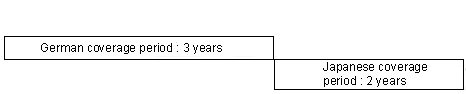
Your coverage period under the German system in this chart is 2 years short to meet the requirement of 5 years to be qualified for the old-age pension. You may not be eligible for the benefits under the German system.
However, the totalization agreement between Japan and Germany enables you to totalize your periods of both Japan and Germany to fill the gap for benefits under the German system so that you may qualify for benefits.
After agreement
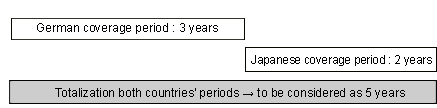
Your coverage period under the German system in this chart is not long enough to meet the requirement of 5 years to receive the old-age pension. However, your totalized coverage period is 5 years, which will allow you to qualify for the German old-age pension benefits.
The totalization of periods enables you to take into account your coverage period which you earned in Japan, if you do not have enough coverage period in Germany alone to be eligible for the benefits. As a result of the totalization, you may qualify for the benefits.
However, your periods of dual coverage will not be counted twice as long. Only period of one country shall be considered.
Reference: benefits calculation for dual coverage periods
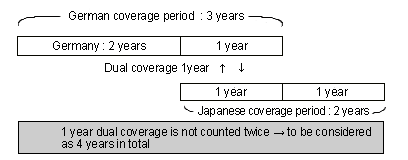
The idea of totalization is that your totalized coverage period is taken into account when your eligibility to benefits is determined.
Each country will respectively calculate your benefits which are corresponding to your coverage period under each country's system, and will pay you respectively. Please note it is not that the benefits amounts corresponding to your all totalized coverage period will be paid by one of the two countries.
In the same manner, in order for you to satisfy coverage period requirements for disability pension and survivors' pension, you may be able to totalize your Japanese period and German period.
Special Provision for the Benefits Amount Calculation under Agreement
Under the totalization rules, when you meet the eligibility requirement for benefits based on totalized coverage period of both Japan and the other agreement country, your benefits amount of the agreement country will be calculated in proportion to your coverage period under the system of the agreement country, and paid to you.
Please note that your coverage period of Japan will be a factor only in the following benefits calculation.
- Calculation of Belgian benefits
- Calculation of French benefits
- Calculation of Australian benefits
- Calculation of Czech benefits
- Calculation of Spanish benefits
- Calculation of Brazil benefits
Benefits Payable to Abroad
For further information about benefits payable to abroad, please see below.
- Belgium: Benefits payable to outside Belgium
- Australia: Australian benefits amount calculation under the Agreement
- Netherlands: Removal of Dutch pension suspension
- Switzerland: Benefits payable to outside Switzerland
Pension System of Each Agreement Country
Each agreement country’s pension system and rules under each agreement are different. For more information, visit each website of the social security institution / authority in the country.