


Special Provisions for the Japanese Pension Payments
Page ID:140010060-943-311-592
Last updated date:4 1 2026
Japanese pension benefits are paid according to special provisions under the social security agreement.
Index
Special Provisions for Benefits Requirements
- Totalization of periods of two country for old-age benefits
- Coverage periods totalization to qualify for disability / survivors’ Benefits
- Coverage status to qualify for disability / survivors' benefits
Totalization of periods of two countries for old-age benefits
To be eligible for the Japanese pension benefits such as old-age benefits, you must have a certain coverage period under the Japanese pension systems.
If you do not have sufficient coverage period to meet the eligibility requirements for Japanese benefits, the totalization of periods under the agreement country helps fill the gap for the qualification.
Old-age Basic Pension and Old-age Employees' Pension
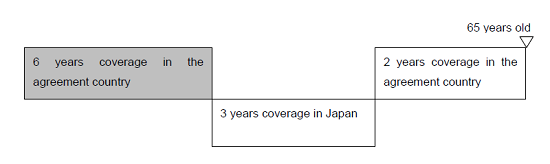
Coverage period required for entitlement is 10 years or longer under the Japanese systems
Without agreement : 3 yrs < 10 yrs → not eligible for the pension benefits
With agreement : 6 yrs + 3 yrs + 2 yrs = 11 yrs > 10 yrs→ eligible for the pension benefits
Additional Benefits for Dependents and Transmittal Add-on Benefits to Spouses*
 * Additional Benefits for Dependent Spouse is to be transferred to add to the spouse’s pension, as Transmittal Add-on Benefits, when the spouse is entitled to his/her own benefits.
Coverage period required for entitlement of such additional benefits is 20 years or longer under the Japanese system.
Without agreement : 7 yrs < 20 yrs → not eligible for Additional Benefits and Transmittal Add-on Benefits
With agreement : 7 yrs + 8 yrs + 15 yrs = 30yrs > 20 yrs→ eligible for Additional Benefits and Transmittal Add-on Benefits
In case of dual coverage
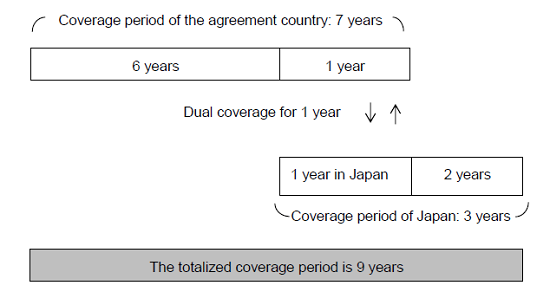
If the contributions were made for both countries for the same period, such periods of dual coverage are not counted twice as long, i.e. totalized coverage period in the chart above are not 10 years but 9 years.
Notes on individual rules under each agreement
For any agreement country that has the minimum coverage period requirement for benefits, the Japanese coverage periods may be taken into account to help fill the gap to qualify for agreement country’s benefits.
Please note that it is not that your totalization pension benefits amounts will be paid from one country. Rather, each country respectively calculates your totalization pension benefits in proportion to your coverage period under each country's system, and pays the benefits of that country to you respectively.
Notes on Individual Rules under Each Agreement
Coverage periods totalization to qualify for disability / survivors’ Benefits
As one of the eligibility requirements for disability and survivors' benefits under the Japanese National Pension / Employees’ Pension Insurance Law, your total contribution-paid and contribution-exempted period must be more than two-thirds of the entire coverage period.
If your total contribution periods to Japanese system is not long enough to satisfy such requirement, your coverage periods under the agreement country's system can be considered as contribution-paid periods under the Japanese National Pension system, which helps you fill the gap to satisfy the requirement.
The same rule applies to the eligibility requirement for Japanese Disability Allowance under the agreements with Belgium, France, Netherlands, Czech Republic, Spain, Ireland, Brazil, Switzerland, India, Luxembourg, Philippines, Slovak Republic, Finland, Sweden, and Austria.
Example: Disability Employees' Pension

Without agreement: 5 yrs/(10 + 5 yrs)= 1/3 < 2/3 → not eligible for the pension benefits
With agreement: (5 + 15 yrs)/(10 + 5 + 15 yrs)= 2/3 ≧ 2/3 → eligible for the pension benefits
However, the benefits are payable only if you have any contribution-paid period or contribution-exempted period under National Pension system and the coverage period under Employees’ Pension Insurance system is zero on date of the first medical examination.
Coverage status to qualify for disability / survivors' benefits
To be eligible for Japanese disability and survivors' benefits, the date of the first medical examination or the date of death must lie within specified coverage periods under Japanese system.
However, the coverage periods under the other agreement country’s system may be considered as those under Japanese system for the purpose of establishing the entitlement.
The same rule applies for Japanese Disability Allowance under the agreements with Belgium, France, Netherlands, Czech Republic, Spain, Ireland, Brazil, Switzerland, India, Luxembourg, Philippines, Slovak Republic, Finland, Sweden, and Austria.
Example: Disability Employees' Pension

Without agreement: Not insured by Employees’ Pension Insurance system on the date of the first medical examination → not eligible for the benefits
With agreement: Considered as insured under Employees’ Pension Insurance system on the date of the first medical examination → eligible for the benefits
Special Provisions for Benefits Amount Calculation
When you are entitled to the totalized Japanese pension benefits, the benefits amount is calculated on the basis of the coverage period that you paid contributions to the Japanese systems.
Following is one sample of insurance coverage history. Without totalization, this case does not have enough Japanese coverage periods to qualify for Japanese benefits.
With totalization of periods of two countries, Japanese benefits are provided, whose amount is calculated based only on Japanese periods. See below to learn more details.

- Benefits amount calculation based on the length of coverage period (e.g. old-age benefits)
- Benefits calculation of fix amount irrespective of the length of coverage period (e.g. Disability / Survivors' Basic Pension)
- Benefits calculation of additional benefits amount by satisfying coverage period requirement
Benefits amount calculation based on the length of coverage period (e.g. old-age benefits)
The totalized Japanese benefits amount is calculated based on the proportion of Japanese coverage period according to the Japanese pension laws.
Type of benefits
- Old-age Basic Pension
- Old-age Employees' Pension
- Survivors' Employees' Pension (for long-term coverage period)
Example: Old-age pension
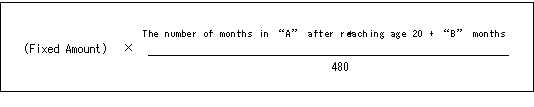 Formula for Old-age Basic Pension
 Formula for Old-age Employees' Pension
Benefits calculation of fix amount irrespective of the length of coverage period (e.g. Disability / Survivors' Basic Pension)
The benefits such as Disability Basic Pension are provided in fixed amount irrespective of the length of coverage period.
The totalized Japanese benefits amount is calculated in proportion to the coverage period under the Japanese pension system by using specified rate, as long as the eligibility requirements for benefits are satisfied by the agreement.
The specified rate varies according to each agreement. See below for details.
Type of benefits
- Transmittal Add-on Benefits to Spouses’ Old-age Basic Pension (only for benefits for a spouse of a person eligible for Disability Employees' Pension or Disability Mutual Aid Pension)
- Disability Basic Pension
- Disability Employees' Pension
- Additional Benefits for Spouses to Disability Employees' Pension
- Survivors' Basic Pension
- Survivors' Employees' Pension
- Additional Pension for Middle Age Widows and Transitional measure for Additional Pension for Widows to Survivors' Employees' Pension (for short-term coverage period)
- Disability Allowance
Example: Disability Basic Pension
- Under the agreements with U.S., Canada, Brazil, India and Philippine

* The “theoretical period” generally means the period for which a person can be covered by the Japanese systems to be eligible for benefits (from age 20 to 59 after April,1961,) excluding the period after the date of death or from the date of disability recognition.
- Under the agreements with Germany, Belgium, France, Netherlands, Czech Republic, Spain, Ireland, Switzerland, Luxembourg, Slovak Republic, Finland, Sweden, and Austria

Example: Disability Employees' Pension (Total coverage period is less than 300 months)
- Under the agreements with U.S., Canada, Brazil, India and Philippine

* The “theoretical period” generally means the period for which a person can be covered by the Japanese systems to be eligible for benefits (from age 20 to 59 after April 1,1961,) excluding the period after the date of death or from the date of disability recognition.
- Under the agreements with Belgium, France, Netherlands, Czech Republic, Spain, Ireland, Switzerland, Luxembourg, Slovak Republic, Finland, Sweden, and Austria

- Under the agreement with Germany

Benefits calculation of additional benefits amount by satisfying coverage period requirement
Under the Japanese pension system, following additional benefits are provided in a fixed amount as long as the insured person has a certain coverage period.
When the eligibility requirements are satisfied by totalizing both periods of Japan and the agreement country, the benefits amount is calculated according to the proportion of his/her Japanese period against the total coverage period needed for the benefits.
Type of benefits
- Transmittal Add-on Benefits to Spouses’ Old-age Basic Pension
- Additional Benefits for Dependents to Old-age Employees' Pension
- Additional Pension for Middle Age Widows and Transitional measure for Additional Pension for Widows to Survivors' Employees' Pension (for long-term coverage period)
Example: Additional Benefits for Dependents to Old-age Employees' Pension

*Depending on your date of birth, the number of months can be between 180 and 240 months.
Other Special Provisions
- Special provision: One agreement totalizes Japan and one country, not other countries
- Special provision: Suspension of additional benefits (e.g. Transmittal Add-on Benefits to Spouses' Old-age Basic Pension)
- When the totalization pension benefits are payable
- Special provisions of former pension law
- Lump-sum Withdrawal Payments and totalization pension benefits
Special provision: One agreement totalizes Japan and one country, not other countries
Even if you are covered under two or more other agreement countries' systems, you can totalize your Japanese coverage periods only with one agreement country’s coverage periods. (Needless to say, totalization is only available between countries with agreement including totalization arrangement.)
If you satisfy eligibility requirement for more than one totalization pension benefits based on your coverage periods in each country respectively, the one with highest benefits among them is provided.
Special provision: Suspension of additional benefits (e.g. Transmittal Add-on Benefits to Spouses' Old-age Basic Pension)
In principle, Additional / Transmittal Add-on Benefits for (deriving from) dependent spouses provided on top of the old-age or disability benefits are suspended when the spouses become eligible for his/her own Old-age Employees’ Pension (with more than 240 EPI insured months) or disability benefits.
However, under the agreements, Additional / Transmittal Add-on Benefits are not suspended even when the spouses become eligible for totalization pension benefits. Please note that when both husband and wife are entitled to these benefits respectively, the one with higher amount among the two is provided.
If you are entitled to two or more Additional Benefits provided both by JPS and by Mutual Aid Association, the one with highest amount will be provided and the others will be suspended until the highest one is suspended.
When the totalization benefits are payable
A person is eligible when he/she satisfies all eligibility requirements including coverage period requirement. Therefore, without the agreement, there were many persons who could not satisfy the coverage period requirement.
However, with the implementation of the agreement they may become eligible for benefits (based on totalization provisions.) For such persons, benefits are entitled on the effective date of each agreement.
Special provisions of former pension law
Former National Pension Law: Eligibility requirements for Coordinated Old-age Pension
- The said special provisions also apply to the eligibility requirements for Coordinated Old-age Pension which is specified under the former National Pension Law (before the 1985 amendment.)
Practically, with the help of special provisions, persons who did not satisfy coverage period requirement for Coordinated Old-age Pension under the former National Pension Law can now totalize their coverage period of both Japan and other country and may be eligible for Coordinated Old-age Pension. - If persons are eligible for disability benefits specified under the former National Pension Law, and the date of their first medical examination of another disability was during the coverage period of the other country, they are considered to be insured under National Pension system of Japan on the date of their first medical examination and to be eligible for Disability Basic Pension with the help of special provisions. In this case, your disability benefits will be reviewed.
Please note that the cases are excluded when another Disability Basic Pension is provided due to another disability subject to Disability Basic Pension.
Former Employees' Pension Insurance Law: Eligibility requirements for Old-age Pension
- The said special provisions also apply to the eligibility requirements for benefits, such as Old-age Pension or Coordinated Old-age Pension, which is specified under the former Employees' Insurance Pension Law (before the 1985 amendment.)
Practically, with the help of special provisions, persons who did not satisfy coverage period requirement for Old-Age Pension or Coordinated Old-Age Pension under the former Employees' Pension Insurance Law can now totalize their coverage period of both Japan and other country and may be eligible for Old-Age Pension or Coordinated Old-Age Pension. - If persons are eligible for disability pension benefits specified under the former Employees' Pension Insurance Law, and the date of their first medical examination of another disability was during the coverage period of the other country, they are considered to be insured on the date of their first medical examination and to be eligible for Disability Employees' Pension with the help of special provisions. In this case, your disability benefits will be reviewed.
Lump-sum Withdrawal Payments and totalization pension benefits
IMPORTANT
Non-Japanese people who work in Japan for some years and leave Japan may receive Lump-sum Withdrawal Payments (one time only payments, payable within two years from departure) if you have at least six months contribution under National Pension or Employees’ Pension Insurance.
YOU MUST NOTE, however, that once you receive the Payments, your Japanese coverage periods which were taken to calculate the Payments amount will no longer valid to be totalized for future pension benefits. Please consider well and make your decision between one time payments or future annual pension benefits.